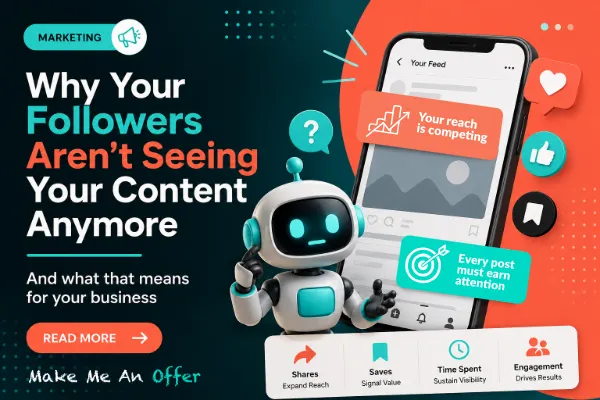
Why Your Followers Aren’t Seeing Your Content Anymore
And what that means for your business
If you’ve been using social media since the mid 2000s, you have likely noticed a shift in how it works.
What once felt like a way to stay connected to people you knew now feels less personal and less predictable. You are seeing more content from people you do not follow, while often missing updates from those you intentionally connected with.
For business owners, this is more than just a change in experience. It directly impacts how your content is seen and how your audience engages with you.
How Social Media Started (and where businesses fit in)
Social media did not start as a business tool.
When Facebook launched in 2004, it was designed for university students to connect with each other. [en.wikipedia.org]
It then expanded:
From universities → workplaces and networks
And by 2006, to the general public [populartimelines.com]
In those early years, it was built around people and relationships.
Businesses were not originally central to the experience.
When businesses entered the picture
In 2007, Facebook introduced Pages for businesses and brands, allowing companies to connect with users in similar ways to personal profiles. [about.fb.com]
This was a turning point.
For the first time:
Businesses could be followed
Customers could engage directly
Marketing became more conversational
And it worked well, because the system was still connection-based.
If someone followed your business, they typically saw your content.
What Changed
The shift from connection to content
As usage grew, so did content volume.
Platforms could no longer show everything in order, so they introduced algorithms to prioritize what people see.
Over time, this evolved into a much more complex system.
Today, platforms prioritize:
Engagement
Behaviour
Attention
Your reach is no longer determined primarily by your follower count alone.
Connection still matters, but it now competes with behavioural signals, content performance, and recommendation systems.
From “who you know” to “what you engage with”
Social media has shifted from:
A network of relationships
→ toA system of content discovery
This means:
You see more content from people you do not follow
Followers are not guaranteed to see your posts
Every post must earn attention
What was once connection-based is now performance-driven.
Why It Feels Less Personal
That feeling is real.
You are no longer primarily seeing updates from your network. Instead, you are seeing what platforms predict will hold your attention. And the same is true for your audience.
They are no longer consistently seeing content from the people and businesses they follow. Your posts are now competing with everything else the platform thinks they might engage with.
This is why:
You miss posts from people you follow
Your audience misses posts from you
Your feed feels less familiar
What was once about keeping up with people is now about consuming content.
What This Means for Your Reach and Visibility
If your approach has not evolved, it creates a gap.
You may be:
Posting updates the same way
Expecting followers to see content
Measuring success based on likes
Which often leads to:
Lower reach
Inconsistent engagement
Frustration
But social media is not failing.
It is working as designed. It is simply rewarding different behaviours.
The Most Important Shift to Understand
Not all engagement carries the same weight anymore.
A like is a quick reaction.
A comment shows some level of interest.
But a share or a save signals something much stronger.
It indicates that someone sees enough value in the content to either pass it along or return to it later.
What actually drives reach
Platforms now prioritize signals that extend reach or deepen engagement:
Shares → expand your audience
Saves → signal long-term value
Time spent → sustain visibility
For example:
A post with 200 likes but very few shares or saves may stop circulating quickly.
Meanwhile, a post with 30 shares and 10 saves can continue reaching new audiences long after it is published.
Why This Is Challenging for Business Owners
This is not about skill. It is about expectations.
You learned social media as:
A communication tool
A relationship builder
A place to post updates
Today, it functions as:
A content engine
An attention system
A discovery platform
So when results change, it is not necessarily a reflection of your business.
It is often a reflection of how the system now works.
What Is Working Now
The businesses seeing results are not doing more. They are doing things differently.
They have shifted from:
Posting updates → creating engaging content
Speaking only to followers → attracting new audiences
Measuring likes → measuring behaviour
They ask:
Would someone share this
Would someone save this
Would someone spend time on this
If not, it is unlikely to travel far.
Using Your Tools More Strategically
Many of our clients already have tools that can help. The difference is knowing what to look for.
Our HighLevel clients have social planner features including:
Social listening
Trend monitoring
Cross-platform tracking
Content planning tools
These can help you identify:
What topics people are paying attention to
What types of content drive interaction
Where audience attention is shifting
The real opportunity
It is not just tracking numbers. It is understanding behaviour.
Shift from:
“How many people liked this?”
to“How did people engage with this?”
Look for patterns:
What gets shared
What gets saved
What holds attention
What continues gaining traction over time
Your tools are not just reporting systems.
They are insight systems.
A Simple Way to Rethink Your Content
Before posting, ask:
What would make someone pause
What would make them share it
What would make them come back to it
Because today:
Likes show awareness
Shares show value
Saves show intent
Final Takeaway
Social media has not become less effective.
It has become less connection-based and more behaviour-driven.
It is no longer primarily a communication tool.
It is now a recommendation system.
The businesses that adapt are the ones creating content people actively choose to engage with, not just passively scroll past.
Businesses that understand that shift are far more likely to adapt successfully.
If you are unsure where to start
If you are looking at your content and not sure what is working or why, you are not alone.
The challenge is not lack of effort. It is interpreting what the data is actually telling you.
Sometimes a small shift in what you measure and how you respond to it can make a significant difference.
References
History of Facebook, including early platform development and expansion beyond universities (2004–2006)
Wikipedia
[en.wikipedia.org]
Facebook Timeline, outlining the platform’s transition from student network to public platform
Popular Timelines
[populartimelines.com]
Facebook Ads Launch, marking the introduction of business pages and brand participation (November 2007)
Meta Newsroom
[about.fb.com]