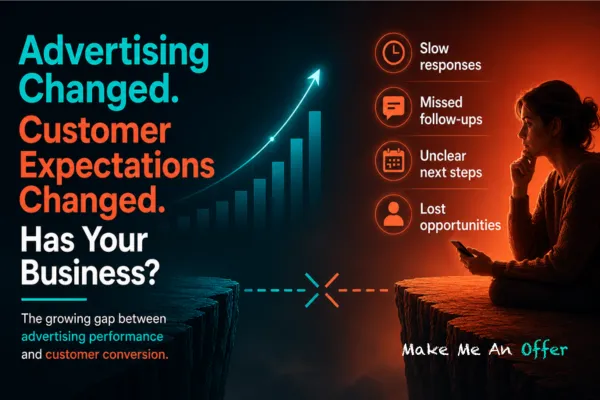
Advertising Changed. Customer Expectations Changed. Has Your Business?
The growing gap between advertising performance and customer conversion
Businesses are spending more on advertising than they were a year ago and yet many feel less confident in the results.
Leads feel inconsistent.
Follow-up feels overwhelming.
And platforms like Meta and Google are changing faster than most businesses can realistically keep up with.
In most cases, the issue comes down to two major shifts.
Part 1: What Changed in Advertising (2025 → 2026)
If you’ve been running ads over the past few years, you’ve likely felt it.
Things aren’t necessarily worse.
But they are less predictable.
That’s because the way advertising platforms operate has changed significantly.
Platforms Are Doing More of the Work
Meta and Google are now heavily driven by AI systems that:
expand who sees your ads
test multiple versions of your content
decide where and when ads are delivered
Instead of manually controlling everything, businesses are now:
providing inputs
while the platform handles optimisation
This shift toward AI-driven campaign execution and automation has become the default across both Meta and Google Ads. [2pointagency.com], [about.fb.com]
What This Looks Like in Practice
Many businesses are now seeing:
more leads, but lower intent
inquiries outside their service area
more conversations that don’t convert
higher engagement without stronger sales
This doesn’t mean ads aren’t working.
It means the system is behaving differently.
Creative Has Become the New Targeting
In 2025, performance often came from refining audiences.
In 2026, it comes from refining messaging.
Instead of asking:
“Who should see this ad?”
The better question is:
“Is this clear enough that the right person will act on it?”
Because the platform is now doing most of the matching for you.
The Real AI Shift (What Most Businesses Missed)
In late 2025, many businesses leaned heavily into:
automated targeting
AI-driven campaign recommendations
auto-generated ad variations
Assuming more automation would improve results.
But in reality:
broader targeting increased variability
AI-generated messaging often became less specific
and advertisers lost visibility into how decisions were being made
The result?
More activity — but less consistency.
Not All Businesses Experience This the Same Way
Different business models are affected differently.
Service businesses often struggle with location and intent
Product-based businesses see shifts in conversion behaviour
Virtual or community-driven offers require more trust and engagement
Which is why there is no single “best” approach anymore.
One Final Shift to Understand
This isn’t just about platforms.
It’s about expectations.
People now expect:
faster responses
clearer next steps
less friction in taking action
And platforms are built around that behaviour.
What This Means Moving Forward
If your ads feel inconsistent, it’s often not because they’re failing.
It’s because:
the system changed
and your approach hasn’t fully adapted yet
👉 In the next section, we’ll look at why ads alone no longer drive results — and what actually happens after someone engages.
Why Ads Alone Aren’t Enough Anymore
One of the biggest misconceptions in advertising is this:
If the ad works, the sale should follow.
But ads don’t close sales.
They create attention.
Part 2: Leads Come In — But Don’t Convert
This is where most businesses get stuck.
Leads are coming in.
But they aren’t consistently turning into sales.
Not because the leads are bad.
But because most people don’t act immediately.
They are:
comparing options
checking reviews
reaching out at different times
or getting distracted
A lead is not a decision. It’s a moment of interest.
A Reality Many Business Owners Are Facing
Many business owners are doing everything they can to keep up.
They’re:
running ads
replying between appointments
trying to follow up manually
And still wondering why results feel inconsistent.
Not because they’re doing something wrong —
but because expectations have changed.
Where Opportunities Are Lost
The biggest gap isn’t in the ad.
It’s what happens next.
replies come too late
there’s no clear next step
booking feels unclear
no one follows up after the first interaction
At the same time, people expect immediate responses.
If they don’t get that, they move on.
Often to the first business that replies.
Why This Feels Like a “Lead Quality” Problem
From the business side:
“These leads aren’t serious.”
From the customer side:
“I didn’t hear back fast enough.”
“I didn’t know what to do next.”
The gap isn’t always the lead itself.
It’s what happens after.
This Is Where Systems Make the Difference
The businesses seeing consistent results aren’t just running ads.
They’ve built systems around them.
faster response time
clearer booking paths
consistent follow-ups
better overall experience
Ads don’t just generate leads. They create moments of opportunity.
And those moments don’t last long.
The Real Insight
Most businesses try to fix one side of the problem.
either the leads
or the follow-up
The ones that grow fix both.
Paid ads are not a standalone solution.
They are the entry point into a system.
What This Means for Your Business
If your advertising feels inconsistent, it doesn’t mean it stopped working.
It means:
how people engage has changed
how platforms deliver content has changed
and the system around your ads may not match that shift yet
A Different Way to Think About It
In 2026, businesses don’t necessarily need more advertising.
They need:
clearer messaging
stronger follow-up systems
better customer journeys
and a more connected approach between marketing and operations
Final Thought
Ads create attention.
Systems determine whether that attention ever turns into revenue.
If This Feels Familiar
If your ads feel less predictable than they used to, you’re not alone.
And it may not be your ads.
It may be what’s happening around them.
If you’d like help evaluating your current advertising and follow-up systems, you can connect with Paige at MMAO.
References
Meta advertising automation and AI-driven campaign delivery systems (2025–2026)
Industry analysis of Advantage+ and AI-powered ad distribution
[2pointagency.com]
Google Ads AI-based campaign evolution, including Performance Max and AI Max
Google Marketing Live platform updates and automation rollout
[about.fb.com]
Creative performance trends and short-form video engagement data
Industry benchmarks showing the shift toward content-driven performance
[whitelabelagency.co]
Paid ad conversion benchmarks indicating most users do not convert immediately
Typical industry conversion rates (1–5%)
[medium.com]
Lead response speed and its impact on customer conversion
Harvard Business Review and MIT lead response research
[thejonasagency.com]
Meta lead generation methods and the tradeoff between volume and quality (lead forms vs landing pages)
Industry comparison of conversion rate vs lead intent
[en.wikipedia.org]